
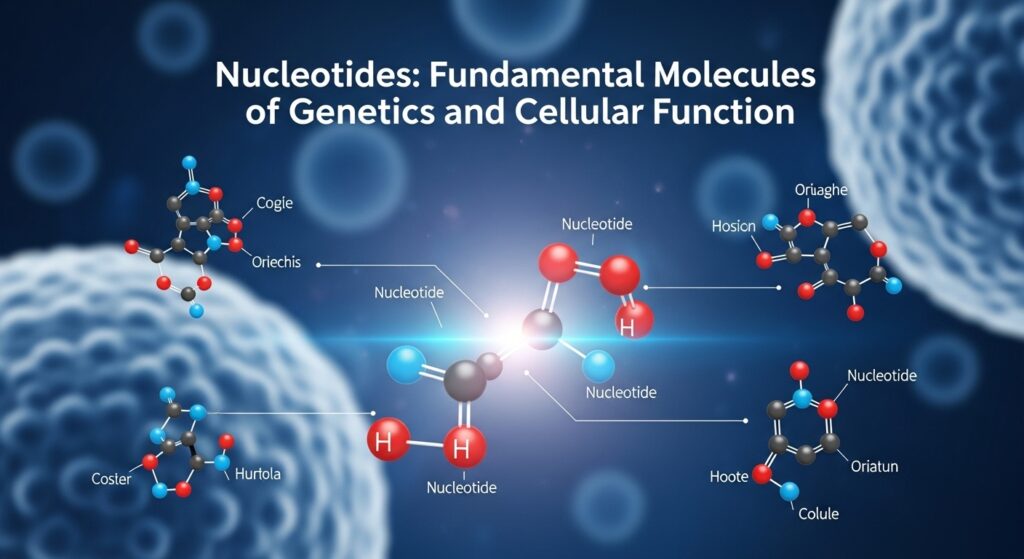
Nukleotidy are essential organic molecules that serve as the building blocks of genetic material in all living organisms. They form the structural units of DNA and RNA, enabling the storage, transmission, and expression of genetic information. Without nukleotidy, life at the cellular level would not be possible.
This article explores the structure, types, biological roles, and scientific importance of nukleotidy, highlighting their central role in biology and modern research.
What Are Nukleotidy?
Nukleotidy are small biomolecules composed of three key components:
-
A nitrogenous base
-
A five-carbon sugar
-
One or more phosphate groups
When these three elements combine, they form a nucleotide. Multiple nucleotides link together to create nucleic acids, which include DNA (deoxyribonucleic acid) and RNA (ribonucleic acid).
Structure of Nukleotidy
Each part of a nucleotide has a specific function.
Nitrogenous Bases
There are five primary nitrogenous bases:
-
Adenine (A)
-
Guanine (G)
-
Cytosine (C)
-
Thymine (T)
-
Uracil (U)
In DNA, the bases are adenine, guanine, cytosine, and thymine. In RNA, uracil replaces thymine. These bases pair in specific ways: adenine pairs with thymine (or uracil in RNA), and guanine pairs with cytosine.
Sugar Component
The sugar in DNA is deoxyribose, while RNA contains ribose. The slight structural difference between these sugars contributes to the stability of DNA and the flexibility of RNA.
Phosphate Group
Phosphate groups connect nucleotides together through phosphodiester bonds. This forms the backbone of DNA and RNA strands, providing structural integrity and directionality.
Role in DNA Structure
Nukleotidy form long chains that twist into the double helix structure of DNA. This structure was famously described by James Watson and Francis Crick in 1953.
The sequence of nucleotides along a DNA strand determines genetic information. This sequence acts like a biological code that instructs cells how to produce proteins, regulate functions, and replicate.
Role in RNA and Protein Synthesis
RNA is also composed of nucleotides, but it usually exists as a single strand. It plays several important roles in gene expression:
-
Messenger RNA (mRNA) carries genetic instructions from DNA to ribosomes.
-
Transfer RNA (tRNA) helps assemble amino acids into proteins.
-
Ribosomal RNA (rRNA) forms part of the ribosome structure.
Through these processes, nucleotide sequences are translated into functional proteins, which carry out most cellular activities.
Energy and Metabolism
Beyond genetic storage, nucleotides play a critical role in energy transfer. One of the most important molecules in this context is adenosine triphosphate (ATP). ATP stores energy in its phosphate bonds and releases it to power cellular processes such as muscle contraction, active transport, and biosynthesis.
Other nucleotide derivatives also participate in metabolism and cellular signaling.
Cellular Communication
Certain nucleotides function as signaling molecules within cells. For example, cyclic AMP (cAMP) acts as a secondary messenger in various biological pathways. These molecules help cells respond to hormones, environmental changes, and internal signals.
Importance in Cell Division
Accurate replication of DNA during cell division depends on nucleotides. Specialized enzymes copy nucleotide sequences to produce identical DNA strands. This ensures genetic consistency across generations of cells.
Errors in nucleotide replication can lead to mutations. While some mutations are harmless or beneficial, others may contribute to diseases such as cancer.
Nukleotidy in Modern Science
Advances in molecular biology have made nucleotide research central to many scientific fields.
Genetic Testing
DNA sequencing technologies analyze nucleotide sequences to detect genetic disorders and inherited conditions. This supports personalized medicine and targeted treatments.
Biotechnology
Genetic engineering techniques allow scientists to modify nucleotide sequences to create improved crops, produce medicines, and develop industrial enzymes.
mRNA Vaccines
Messenger RNA technology, used in modern vaccines, relies on synthetic nucleotide sequences to stimulate immune responses. These vaccines demonstrate how understanding nucleotides can lead to rapid medical innovation.
Evolutionary Significance
Changes in nucleotide sequences over time drive evolution. Small variations accumulate across generations, contributing to species diversity. By comparing DNA sequences, scientists can trace evolutionary relationships and reconstruct the history of life.
Future Perspectives
Research into nucleotides continues to expand with technologies such as CRISPR gene editing. These tools allow precise modification of nucleotide sequences, offering potential treatments for genetic diseases and new agricultural solutions.
However, ethical considerations are important. Responsible use of genetic technologies ensures that scientific progress benefits society while minimizing risks.
Conclusion
Nukleotidy are the foundational molecules of life. They form the structure of DNA and RNA, power cellular processes, and enable communication within and between cells. Their influence extends beyond biology into medicine, biotechnology, and evolutionary science.
Understanding nucleotides provides insight into how living organisms function at the most fundamental level. As research continues to advance, nucleotides will remain central to discoveries shaping the future of health, science, and technology.